 I really love scenic views, particularly panoramic mountain views.
I find they have a powerful psychological/therapeutic/morale effect.
Help to put life's little problems into perspective.
Just behind our house is a hill from where, after a 5 minute walk, we have a 360° view including the Black Forest on one side & the Vosges on the other.
On a good day, we can see several identifiable peaks 100 km away.
That's one of the reasons we bought this house.
We do quite a bit of walking in these nearby hills, and when choosing a route, one with lots of viewpoints indicated will be high on the priority list.
We noticed, many years ago, that the marked viewpoints in the Black Forest were beginning to lose their views, due to new trees being allowed to grow just in front.
These days, France is catching up, and an increasing number of viewpoints, even marked on maps, even signposted, even equipped with nice benches by the "Club Vosgien", only let you gaze at close-up trees, just like you could anywhere else.
 Of course I like trees & appreciate their invaluable contribution to our well-being.
I have lots & have planted more, and I consider myself reasonably ecological in most ways.
But I would really like to remove or reduce the small number which block otherwise breathtaking views.
Ready to plant some new ones on a one-for-one basis.
OK – two-for-one if you insist.
I think that would leave the world a better place.
Parting thot:"The tree which moves some to tears of joy is in the eyes of others only a green thing that stands in the way." - William Blake
 Nobody would be surprised to find that the French, and other Latins, are less fanatically punctual than, say, the British, Germans or Scandinavians.
Not being too bound to the clock is almost a matter of pride & self-image.
Like not being too bound to rules in general.
"Savoir vivre" if you like.
I have to admit that, personally, I still like the split-second timing I still see on BBC TV, even to the numerical count-down to the start of the news.
And I still find I am irritated by French TV channels' apparently voluntary inability to finish any political discussion program within half an hour of the advertised time, with all the knock-on (or knock-out) consequences for subsequent programmes.
But the detail which irritates, infuriates & bemuses me the most, several times a day, is that they keep starting the news programmes 2 or 3 minutes before the advertised time – yes, early.
Why would anybody want to do that, other than to smack their customers in the face?
It's like running buses or trains earlier than the timetable – customers who follow the rules miss out & legitimately feel cheated.
Parting thot: "Value is created by getting the right information to the right place at the right time." - George Huber
 A few years ago, we bought a bread machine.
Not that there was anything wrong with the bread we could buy.
Quite the opposite in fact, even the local supermarket bread is really first class, with a lot of choice in interesting crusty brown seedy stuff as well as various baguettes, and there are several good bakers on our normal shopping routes too.
But there is nothing within 5 km & nothing open on Sunday or holidays or late at night, of course.
And we have a lot of holidays.
So it's handy to have the machine for emergencies, and just for playing with.
Of course we could (& do) keep emergency loaves in the freezer, but that's no fun.
Surprisingly, not only is the bread machine easy to use, but it works quite well & has produced hardly any door-stops, though I still can't get rid of a lingering yeasty taste.
Nor the irritating hole in the bottom, of course, where the loaf is cooked around the beater.
Having bought the machine, we then needed flour, preferably interesting flour with bits in.
This is not an area I had looked at much, but we soon found that our usual shops had a good selection.
Interestingly, they have not only the nationally known brands, but also flour from local mills.
 That's how we discovered that there is a real live working flour mill just a couple of villages away.
We should have know about it already, because we often use the good Tarte-Flambee Restaurant next door, which is called "Le Moulin", but we assumed it was commemorating an ex-mill, not an alive-&-kicking one.
 The illustrations here are from an open day, when the public could wander round all the antique wooden machinery driven by flat leather belts, just like something out of Charles Dickens (though it only dates from the 1920s).They may look Dickensian, but they have a good website, understandably not in English, with all their 29 different varieties of flour, both bio & regular, and some interesting recipes, and even possible delivery.
 http://www.moulin-hurtigheim.fr/
A very satisfactory find & a good piece of local "industry" to support.
Parting thot: "Old bread is not hard. No bread, that is hard." – Swiss/German proverb?
 When we came to France in 1977, we were appalled by French driving.
Aggressive, selfish & pig-headed, just about summed it up.
And this was around Strasbourg, not in notorious Paris.
Nobody (except visiting Germans) would ever give way for a pedestrian, even on a crossing.
Nobody would pause or slow enough to allow a car out of a side road if it didn't have "priority on the right".
Cars all seemed to have dents & scrapes which were not worth removing.
There were no roundabouts, except the famous one in Place de la Concorde in Paris, which had priority on the right so would lock solid as soon as there was enough traffic.
Just traffic lights which seemed to have only an advisory role.
There has been a huge improvement since then, and it seems to be accelerating.
Contributing factors have been the widespread adoption of radar speed traps (in spite of advanced warning signs for the fixed ones), widespread application of breathalyzer testing, hesitant then plethoric introduction of roundabouts, reduced speed limits in towns, speed humps & traffic-calming chicanes, etc.
None of the above really explains that not only the accident rate, but also the attitudes have changed.
I don't have an explanation either, and I just hope it continues.
That trend seems in opposition to the rapid increase in all other kinds of violent behaviour, particularly gratuitous violence by youths.
One certainly positive factor has been the introduction of "conduite accompagnee" (accompanied driving).
Previously, a learner driver, who needed to be 18 before starting, could only be on the road with driving instructors in dual-control cars, so typically only had 20 hours of driving experience, and in very restricted conditions, before taking the driving test & maybe being let loose on his own, with inevitable consequences.
About 20 years ago, they introduced "accompanied driving" which allowed 16-year-olds to take 20 driving lessons with an instructor, then to cover at least 3000 km with one or two named drivers over 28 (normally parents) with a couple of intermediate check lessons before sitting the driving test at age 18.
This has resulted in a big increase in pass rate & a big decrease in accident rate.
I think it has also meant that young drivers see driving in a family environment rather than as some macho rite of passage to adulthood.
Drivers passing their test after accompanied driving get better insurance terms & only need to display an "A" (apprentice) plate, with its associated lower speed limits, for 2 years instead of 3.
We have "accompanied" all 4 kids now, which has not been too stressful…
Of course, we tried not to pass on our less-good habits & short-cuts, so it was good for us too.
We had to fit in with most prevailing methods, even when we don't 100% agree, like staying down in 3rd gear all the time in towns, because otherwise they would not have passed their tests.
But we did add a couple of safety items which are never included here:
1.Keeping the clutch pedal depressed when starting the engine.
2.Using the handbrake for hill-starts.
The French are taught to do hill starts without handbrakes, by feeling for the clutch biting point, then jumping the right foot from brake to accelerator.
It works OK on slight slopes but almost invariably causes some roll-back on steep ones, often with engine stalling too.
It makes hill starts a critical affair when they don't need to be.
So we taught hill starts using the handbrake.
When one of the kids had a check lesson with a new instructor & used the handbrake on a hill, he immediately said "You must be British."
Apparently he teaches lots of non-French kids related to the European Parliament/Council & recognises the British because they use the handbrake at every stop & start.
That's one peculiarity I will stand up for.
Parting thot: "If at noon the King says it is midnight, admire the stars." – Persian proverb which I find very regrettable & the source of many problems
 I graduated in summer 1965 & started work in October.
In those days, finding a job was easy – I applied to 7 car companies, got interviews at all of them & job offers from all except the one I wanted.
That was average.
I am sorry for people looking for jobs today.
By spring 1966 I felt I could afford to upgrade my car from the 1952 Jowett Javelin 6-seater saloon to something a bit newer & more appropriate for, & appealing to, a young, single, freshly-wage-earning engineer.
Logic & emotion met happily at a 1960 Austin-Healey Sprite Mk1, universally known as the "Frog-Eyed Sprite".
Except in America where it is the "Bug-Eyed Sprite".
That's my one above, trying to be a removals van.
If you had to sum up the Sprite in one word, it would almost certainly be "cute", or maybe "friendly" or just "nice" &/or "little".
Apart from being really small, it has the big eyes & hesitant smile of a Walt Disney baby animal, so the automatic reaction, even from old ladies, is "Ahhh!" – as was the case later with the 1992 Renault Twingo. What a pity people think cars have to be "aggressive" to succeed now.
That is a tendency that needs reversing.
This illustration is from:
http://en.wikipedia.org/wiki/Austin-Healey_Sprite
The Sprite was introduced in 1958 as BMC's entry-level sports car, because the MGs had grown too big, and it used a lot of Austin A35 parts including the 948cc engine (but with twin SU carburettors), gearbox, front suspension & rear axle.
Fortunately, it used the rack & pinion steering from the Morris Minor instead of the nasty steering box from the A35.
Rear suspension was unique, by trailing quarter-elliptic springs & trailing arms.
It was probably one of the earliest open cars with unitary body/chassis & the structure was simple & quite rigid.
The complete front end lifted for access to the engine, whereas there was no external access at all to the luggage, which was kept, unsecured, in the big space behind the seats, along with the spare wheel, jack, tools, hood, hood frame & side windows.
They were sliding plastic side windows in metal frames you could screw to the tops of the doors, or keep in plastic bags in the boot.
The doors had no locks or external handles – you simply reached inside & used the internal handles.
After the Morgan 3 wheeler, all that did not shock me as much as it would today.
It even had (non-retracting) 3-point seat belts, the first I had used, though I think they were an optional extra then.
Performance would usually be described as "nippy" which meant it went slightly quicker than the equivalent-engined saloon cars of the period.
Handling was very different from those cars though, due to the lower build, firmer suspension & very quick steering.
In fact I found the steering far too sensitive and with a tendency to over-steer, which made cornering an effortless finger-twitch affair, but needed watching.
My first, and very successful, action was to build an arm rest into the driver's door to stabilize the steering hand on bumps.
I tamed the twitchiness down progressively with slightly bigger rear tyres, much wider rear wheels & a front anti-roll bar.
There was a big market in performance-improvement equipment for most cars in those days, and particularly for the BMC engines used by the Sprite, A35, Minor, Mini etc.
One method was supercharging & Shorrocks produced a kit with a belt-driven vane-type compressor which could be very simply bolted on, increasing power by about 50% & halving 0-60mph time.
I found a kit, second-hand, in "Exchange & Mart" which was the '60s equivalent of eBay.
It was really as simple to fit as they said & I was soon enjoying hugely better performance, better flexibility, and reduced noise, but with, of course, heavier fuel consumption.
Predictably, I then had a big accident which could have been serious, but luckily wasn't.
I hope & believe I learned enough to avoid having any more…
After that, I ran the red Sprite, now with a second-hand white bonnet, for a couple of years, in which time it was thoroughly enjoyable, though increasingly rusty, as was the tradition with British cars of the '50s & '60s.
While I was fitting the white bonnet, I revised the fixings.
Instead of hinging at the back & opening at the front, which was a heavy lift & gave awkward access, I hinged it at the front & clipped it at the back with Triumph Herald latches.
This was much easier to manipulate & gave better access.
Don't understand why they did not do it like that originally.
Some links with pictures & information for the curious:
http://auto.howstuffworks.com/austin-healey-sports-cars3.htm
http://www.classiccarexperience.co.nz/4663/22103.html
http://www.shannons.com.au/marques/marque-of-the-month/?id=G3K56DBBLPA9D30A
http://www.teamsprite.com/AHmag.html
http://www.youtube.com/watch?v=hhdbL8MKmjE&NR=1
http://www.youtube.com/watch?v=Gmsuoq5GyIo
http://home.vicnet.net.au/~mikeg/marqueone/p20.htm
Although less than 50,000 were built, between 1958 & 1961, there seem to be lots still running, with enthusiasts' clubs all over the world.
Not surprising, for such a likeable, cheap, simple toy.
Parting thot: "Adults are just children who earn money." - Kenneth Branaugh
 The common French expression "pas un chat", literally "not a cat", is just about equivalent to the English "not a soul".
It means "absolutely nobody", typically in the street, at a meeting or somewhere people would be expected.
No idea where it comes from.
Parting thot: "Whatever you are, be a good one." - Abraham Lincoln
 I can't say that tying shoelaces has been a significant item in my life.
I don't remember being taught to tie them, I didn't do my share of teaching the kids to tie them, and I just do it automatically without thinking.
I tie them several times a day, sometimes simply & sometimes with an extra hitch.
They occasionally come undone, more often get a bit loose & need tightening, less often are tough to undo, usually if wet.
At least they did until, looking for the best way to lace hiking boots, I came across "Ian's Shoelace Site".
Yes, seriously: http://www.fieggen.com/shoelace/index.htm
If you have several hours to spare, you can browse just about everything there is to know about lacing & knotting shoes & boots there.
And I am sure you did not believe there was so much to know about shoelaces.
The gem is "Ian's Secure Shoelace Knot".
I have been using it for 2 years now, without any extra hitch, and have never had a knot come undone, loosen, or be difficult to undo.
I can't say this has changed my life, made me rich, brought me new friends, or taken inches off my waistline.
But it is one small, surprising, piece of daily satisfaction.
Worth a try.
http://www.fieggen.com/shoelace/secureknot.htm
You might be more tempted by "The World's Fastest Shoelace Knot" complete with video illustration.
http://www.fieggen.com/shoelace/ianknot.htm
Parting thot: "A small step in the right direction is progress; running around in circles is not."
 Since Internet, I get to see UK & US newspapers again.
Or at least I get to browse headlines rapidly, then dip into a few articles every day.
What strikes me, coming back to English-language headlines after French ones, is how tortuously cryptic they are.
French headlines, mainly in the sports pages, occasionally go as far as a pun, but otherwise remain immediately comprehensible.
English (language) ones seem to be having a crypticity (no, it doesn't exist) competition.
Is there an Oscar for the most obscure, misleading, time-to-decipher-wasting headline?
Or is it just an in-joke between writers?
Here are a few I have collected.
Imagine you are a foreign, English-language student trying to wring meaning from these.
Or an automatic translation software writer (though I am certainly not suggesting we change our writing styles for them).
- Immigration fuels rent rises
- Blair set to outline quit plans
- Phone links with LTTE-held area snap
- Doctor training reform delay call
- Dog attack boy stable in hospital
- Stocks eye flat open
- Hero guard slams crash fines for Network Rail
- Ferry girl bar snub for wills
- Kids' jabs bond aid
- Rumsfeld exit lessens threat to nuclear sites, hardliners believe
- Diana jury inquest move prominent
- Poor forces housing 'for decades'
- Democrats Search for Exit Strategy From Iraq Showdown With Bush
- Dead biker family meet watchdog
- Beau cop busted in ma-to-be's slay
- Darling makes banks change pledge
- Conkers win is double over French
- Nato stretch spurs force rethink
- Yahoo profit bolsters takeover defence
- Norman stoic after Open near miss
- House price plunge fuels recession fear
- UK rate futures tumble as rate cut bets unwound
- BBC prank calls row goes to Trust
- Japan Stocks Post Best Weekly Rally in a Month
- Saying Times implied McCain affair, lobbyist sues
Parting thot: "Writing distills, crystallizes & clarifies thought." - Stephen R Covey
 Our nearest little town built a new library a couple of years ago.
It has lots of good books, records, magazines etc & very helpful staff, so we are very pleased to have it.
The architecture always struck me as odd, with wavy roof-line & uneven pink/orange paint, but I can accept that those are matters of taste.
At least it is not boring.
They seem to have got the steps & wheelchair access right too.
 Less good is the sharp concrete wall next to the first parking space, which is just too low to be seen by drivers & just high enough to gouge bodywork instead of nudging tyres when you fail to see it, which lots of paying customers have obviously done already.
 Then this door – aren't you supposed to think what is on both sides of a door when you design it?
 If I decided to hide untidy-looking parked bicycles from easily-shocked eyes (and I wouldn't, because that provides cover for thieves & vandals) then I certainly would not choose a shoulder-high, flame-cut, unfinished, rusty wall of boiler-plate.
Would you?
At first, I thought it was a temporary emergency measure, but then I saw they had used the same technique as a hand-rail for adjacent steps & it is still there 2 years later.
The architect must have wanted it like that. How can I trust his judgment on anything else?
This is just an insult to customers who may rub their hands & clothes on the rough, rusty surface, quite apart from making the new building look derelict already.
I can't imagine what they were thinking of when they designed the bottom corner of the building here. The overhung wedge of earth is totally unusable & ungrowable & just catches wind-blown debris.
Why is it there?
This is the main entrance lobby.
It has a big radiator just behind the door to keep it warm. But no automatic closing spring on the door.
There has been a notice on the door all winter, asking customers to kindly shut it.
Most of them do, but this is a library for small children too…
I never saw a door like that without a closing device.
They needed a co-architect & a check list.
Parting thot: "People think computers will keep them from making mistakes. They're wrong. With computers you make mistakes faster." - Adam Osborne

French bureaucracy has been famously rigid & unhelpful for decades, but is now getting very user-friendly.
There is a "one-stop-shop" Government Administration website called, encouragingly, "Service-Public" which will point you to answers to almost any admin question:
http://www.service-public.fr/
They also answer individual questions rapidly & without too much "langue de bois".
We have been able to make income tax declarations on-line for several years & are even encouraged to do so by extended deadlines, waived requirements for justification end even, for the first few years, a cash incentive.
You can either do it all on-line in real time, or download the forms for tax and so on, in the usual PDF format.
With the PDF option, you can look at them at your leisure & fill them in & print them, all using free Adobe Reader software, which you can download from their sites (but everybody has already).
There is one irritating snag though, with their PDF forms & everybody else's PDF forms.
Sure, you could just print them blank & fill them in by hand, then scan them to keep a copy & send the originals by post.
I hope you wouldn't.
Much better is to fill them in on the PC, where you benefit from the automatic filling of many zones, automatic arithmetic between zones, better legibility etc.
But if you are using Adobe Reader, you can't electronically save the filled-in forms, so you would still have to print them afterwards, before scanning to keep an electronic copy & sending the original by post.
Worse, if you hit a snag part way through, and you always do, then you can't save your work & continue from the same point later on.
Well, you can.
But you need to use something better than Adobe Reader.
Adobe would say you need Adobe Acrobat at 417€.
Fortunately you can use the oddly named Cabaret Stage instead & it's free.
http://www.cabaret-solutions.com/en/
With Cabaret Stage, you can fill your PDF forms in on the PC, with all the advantages of automatic filling, automatic arithmetic & good legibility, plus you can stop & restart as much as you like and save the finished forms electronically for your records.
With luck, you could also send the completed forms as e-mail attachments, but not all correspondents accept that yet.
Cabaret Stage is a badly-needed piece of software which does not seem to have achieved the popularity it deserves.
Parting thot: "There are 10 types of people in the world, those who understand binary and those who don't." - Paolo Massa?
 If we get any choice in reincarnation, I might like to try Architecture.
There must be something very satisfying about marking your territory with a nice bridge or skyscraper rather than by just lifting your leg if you are on the reincarnation "whatever" list.
But I must say I find the idea rather daunting.
You have to get so many wildly different factors right for so many wildly different customers & users & critics.
Sun, wind, rain, corrosion, fatigue, earthquakes, fire, flood, lightning.
Now also ecology, fuel usage, electricity production, sewage recycling, self cleaning.
Not to mention tagging & terrorism.
And demolition (when is that going to start for mortal sky-scrapers?).
At the same time, architects need to watch all the human-scale stuff, like steps, access for the handicapped, acoustics, toilets, heating & ventilation, lighting, glare etc.
It's hard to know how well they do on the big stuff, except we don't get daily news reports of big buildings or bridges falling down, so I suppose they are getting it right.
But it's painfully obvious that they screw up badly on the human-level details that you or I could do ourselves "le doigt dans le nez".
Even I know that steps only work if they are within certain limits of height & spread, and above all that there are absolutely no irregularities.
So how could famous architect Santiago Calatrava design Venice's new Constitution Bridge, for 15 million Euros (budgeted 4 million) with irregular steps which cause innumerable falls & twisted ankles, if not worse?
And fail to allow for wheelchairs or pushchairs?
http://www.guardian.co.uk/world/2008/sep/29/italy.architecture
It isn't as though bridges had just been invented – Venice has lots of beautiful ones which have been working well for centuries, though understandably without wheelchair access.
I can only think the architect was so engrossed in the aesthetics & anti-seismics that he forgot about the steps.
He is not alone.
There are 2 similarly curved new bridges in Strasbourg with the same problem.
One is outside the (impressive & excellent) new Malraux Library which is in converted old industrial buildings.
The bridge has irregular wooden steps with no visual clue as to where their edges are, so disaster is inevitable.
The other is the now-famous Mimram footbridge which you just saw on TV with Obama & Sarkozy & Co.
Interestingly, they have tackled, & maybe solved, the problem here by adding a long shallow chamfer to the corners of the steps (see illustration). I would never have thought of that, but it seems to work, presumably by introducing "fail-soft" into the equation.
Going down, if you get "out of step" then you can feel the error but still correct it.
Going up, you do not stub your toe on the step.
Well done!
The new Malraux Library, for all its merits, has several other obvious & dramatic architectural failures.
There is a long access ramp up to the main door, with good steps & good wheelchair access.
But chamfering off either side of this ramp is a steeper ramp.
When winter came, lots of people slipped on the steeper ramps & broke bones, so they had to rope it off hurriedly.
The reception hall, where staff meet public, is at the bottom of an attractive, 6-floor high, open-plan well.
That's it in the heading picture.
When winter came, it was, of course, freezing cold & they had to hurriedly improvise a reception hall somewhere else.
The floors in the quiet public reading rooms have been lacquered with what is presumably a tough ultra-high-gloss epoxy varnish.
This is smooth & shiny and anybody trying to walk on it in soft rubber soles produces a loud piercing squeak at every step, indeed at every twitch.
On my first visit, I had to leave early because this was causing so much disturbance.
These things don't happen because nobody knows about them.
They are all well known & obvious.
They happen because nobody bothered to check a new proposal against suitable experience databases.
In many ways, being an architect is similar to being an airline pilot.
Both are highly complex tasks with long, expensive training for carefully-selected candidates who then have complete responsibility for millions of Euros & hundreds or thousands of lives.
It would be unkind to think that airline pilots have developed better safety procedures than architects because they are usually at the sharp end of the accident.
But they have the answer.
They have co-pilots & check-lists.
Before taking off, every time without fail, just like DS & I going on holiday:
You know where we are going? – Yup
Got the right maps? – Yup
Filled the tank? – Yup
Shut all the windows? – Yup
Handbrake off? - Yup
Nothing is too silly to check – it's the silly stuff that kills you.
Surgeons are just starting to adopt the same simple "degrading" practices & are immediately avoiding a lot of silly fatal errors.
An early study showed accidental fatalities reduced by 47%.
Architects need co-architects & checklists so that before submitting any project, they humbly confirm they have really, really remembered the steps, really remembered the draughts, really remembered the paint etc etc.
Don't tell me they already do.
It's patently obvious they don't.
Parting thot: "There are no secrets to success. It is the result of preparation, hard work, and learning from failure." - Colin Powell
 Illustration from mydochub.com
Nature has also done a pretty good job in packaging the banana.
Handy, easy-grip size & shape.
Fits reasonably in most bags & pockets.
Cunningly curved so it won't roll away.
Bright & attractive colour without being too shocking.
Built-in colour coding for "best by" date - ripeness & over-ripeness clearly indicated.
Easy opening with no tools & no finger damage or staining.
Progressive opening so you can hold hygienically by the packaging as the fruit is eaten gradually.
Mouth-sized cross-section.
No stones, pips, or runny, sticky juice.
Package folds flat when empty.
Rapidly bio-degradable.
No-extra-cost joke thrown in (but I never actually heard of anybody really slipping on one).
If they would make it re-sealable after half usage, I would give it a perfect 10.
How strange then, that the same company should have given us the orange.
They must have sub-contracted that one to a start-up & not bothered with any customer clinics.
Actually, the inner packaging is not bad.
The handy bite-sized segments contain the delicious but sticky juice in dry-touch membranes which are quite as effective as plastic sweetie wrappers but much less objectionable in the mouth.
The segments hold together well & separate easily when required.
But the outer packaging is a disaster.
That glaring, unsophisticated colour certainly makes the orange easy to find on the shelf, and equally difficult to hide everywhere else.
The spherical shape may economise on packaging material, which is to be commended, and brings ballistic abilities which are of doubtful relevance, but it results in a product which will not fit in most bags or pockets, and too easily rolls off tables & down hills.
Initial opening requires a knife, which then needs cleaning, or tough thumb nails, which then need very thorough cleaning.
There follows 10 minutes of misery trying to pick off the orange outer packaging, which oozes sticky staining oil and unerringly squirts strong acid in both eyes as it doggedly breaks into small pieces rather than sticking together so you can take it off in one go.
Then another 5 minutes picking off the pith.
The admirably named pith.
The final insult is that not only is the packaging not really biodegradable, but the company's own recycling teams (compost heap worms) turn up their noses at it & will go on strike if they find significant quantities in your heap, just like corporation bin-men everywhere.
It was admittedly a good marketing ploy to name the product after the striking colour, so that every time potential customers sit at flashing orange lights or see orange turn signals, they get free commercials drilled right in.
But they should have spent more money on product development & less on marketing.
Really, signing on all the Dutch national sports teams seems like overkill.
And sponsoring Ukrainian revolutions is ethically questionable as well as being probably counter-productive in some times & places.
As for being associated with French telephone companies, well, I don't see the connection.
Still, they did a better job with the orange than with the lychee.
I think they will have to go back to the drawing board with that one.
An outer shell like an armadillo.
When you manage to get that off then you are left holding a wet sheep's eyeball.
If you still feel like eating, then for goodness sake don't bite as nearly all the eyeball is in fact stone.
It will never take off.
Parting thot: "If all printers were determined not to print anything till they were sure it would offend nobody, there would be very little printed." – Benjamin Franklin
 We have had the good fortune of being able to take a skiing holiday most years.
This involves renting an appartment, which needed to be quite big when there were 4 kids but can be quite small these days.
Anyway, we have experienced 20 or 30 different appartments, in the design of which space-economy has always been an obvious preoccupation, sometimes taken to inconvenient extremes, and in the equipment of which you would imagine energy economy would logically be a significant & increasing preoccupation.
So it is surprising that every single one squeezed a bath into the limited bathroom space, rather than a more space-efficient shower cubicle.
Even more surprising is that most of those baths also included a shower head with flexible hose and some even included a wall fixture for attaching the shower head, but not one included a shower curtain.
So the choice is between taking a time-&-energy-wasting bath, or trying to shower while crouching in the bath holding the shower head in one hand, or having a good, efficient stand-up shower then spending 10 minutes trying to mop a flooded bathroom floor & hoping it has not seeped through to the appartment downstairs.
I just don't understand how we got there.
Parting thot: "If you think education is expensive, try ignorance!" - Andy McIntyre
 If your French friends say you have a spider on the ceiling (une araignée au plafond) they may not be commenting on your housekeeping.
The nearest English equivalent would be "bats in the belfry".
So either modify your behaviour or change your friends.
Parting thot: "A true friend stabs you in the front." – Oscar Wilde
 When we moved to France in 1977, pensions were not on our priority list.
Now, they are.
Back then, we vaguely hoped that by the time we needed pensions, western governments & companies and civilization in general would have progressed to the point of taking international mobility into account.
We were certainly guilty of not taking the subject seriously enough and of not keeping our eye closely enough on European developments.
I would advise anybody anywhere to be more watchful than we have been.
So it is with considerable relief that I can now report that Europe does work, more or less, for wandering workers.
UK & French pension authorities do work together, do construct a multi-national working career, do decide that the whole thing is worth a full pension & do decide to each pay their share of a reasonable whole pension.
They even pay it in Euros into a French bank account.
Employers' pensions don't work quite as well, but better than might have been feared.
For us, it did not just happen automatically though.
I seriously woke up to the question 6 months before retirement date and a big multi-page XL spreadsheet shows 153 items of correspondence so far, with the various potential pension providers, most of whom had changed names, addresses, phone numbers etc since previous contacts.
Today's situation is that we have actual cash in the bank from 3 providers & reliable-looking promises from a fourth, so we can at last start breathing more easily again.
That situation is so good, compared with what it might have been, and compared with the sad plight of all the people currently losing jobs & in some cases associated pensions, that the following remarks should be taken as academic quibbles & certainly not as moaning complaints.
The combined state & employers' pensions should be enough to live on, carefully rather than comfortably.
That implies keeping a regular, careful eye on income, expenditure & balance.
No problem – I have done a monthly account for at least 20 years.
During that time, the main income (salary) & the main expenses (credit card) happened predictably on fixed dates each month, so it was easy to see at a glance whether the month was positive or negative and to react when necessary to stop trends developing.
That control will be more necessary with a pension income.
But will not be so easy.
French state pension is paid into the French bank in Euros on a fixed date monthly, as you would expect.
French employer's pension is paid into the French bank in Euros, but quarterly.
UK state pension will be paid into the French bank in Euros, but every 4 weeks, not monthly.
It is obviously defined in Sterling & I don't yet know what kind of exchange & transfer rates they will achieve.
UK employer's pension is paid monthly, but only in Sterling & only into a UK bank account, from where shipping to France will cost relatively more with increasing frequency & with my poor bargaining position with banks, bless their little hearts!
So keeping track of creeping deficits is going to be difficult, just when it gets more critical.
Again, I am not asking anybody to feel sorry for me here, just pointing out that there are some obviously better & some obviously worse ways of paying pensioners, and I wonder why 3 out of 4 providers would choose an apparently worse way.
Parting thot: "Happiness is proportional to rate of improvement of material circumstances."
 Being so near the border, we were able to get German TV stations even before satellites & digital.
Nowadays I suppose nearly everybody can.
One happy side effect has been that for years we have been able to join about half the German population in their annual New Year's Eve ritual.
If you don't know what that is, you would certainly never guess.
Every year, on several TV channels, they all watch the same, black & white, English-language commedy sketch called "Dinner for One".
Year after year!
Written in the '20s, the 18 minute version which is broadcast actually dates from 1963 & has Freddie Frinton as on old butler waiting on a 90 year old Dutchess (or similar) played by May Warden who is hosting her birthday party as ever, though all her traditional guests have now died.
The butler has to stand in for all the absent guests, particularly in drinking their toasts, so gets progressively very, very drunk.
Every time he moves between the table & sideboard for new drinks, he has to cross a tiger-skin rug with complete head sticking up, which is just obviously going to trip him up this time or next time.
The dialogue is rudimentary & repetitive & that is about it really.
But it is well enough played for millions to watch it every year without fail, as part of a very unlikely national, or now international ritual.
You can see the broadcast version anytime, and I do recommend it, at:
http://video.google.com/videoplay?docid=9105942950207814319
Skip the first 2 minutes German introduction if you like.
Article with more details on the origins & continuing spread of this phenomenon, now apparently gripping not only Germany, but Denmark, Norway, Sweden, Finland, Faroes, Austria, Switzerland, South Africa & Australia:
http://en.wikipedia.org/wiki/Dinner_for_One
It would be interesting to see a good sociological/psychological analysis of this quite illogical but charming popularity.
Parting thot: "Experience is a comb which nature gives to men when they are bald." – Persian proverb
 In 1965, after a couple of years with the Morgan 3-wheeler as my everyday, all-year-round transport, I felt I needed & deserved a bit of warmth & comfort.
So I bought a 1952 Jowett Javelin for £50.
Jowett had been making rudimentary cycle-cars & light commercial vehicles since about 1910 but in 1947, seemingly out of nowhere, they introduced the astonishingly advanced Javelin saloon.
About as far as you can get from a Morgan 3-wheeler, the Javelin was a very expensive, very aerodynamic 6-seater "sports saloon" with a 1.5 liter alloy flat-4 engine.
The "unitary" body/chassis still had a recognizable box-section chassis frame, but this was exceptionally well-designed & rigid.
Front suspension was by double wishbones with torsion bars & telescopic dampers, while at the rear was a rigid axle but again with torsion bars, telescopic dampers, 4 trailing arms & a Panhard rod.
The suspension was long-travel, soft, precise & just beautiful.
Steering was by a unique "pinion & internal sector" system which gave all the precision of the then-new rack & pinion systems, without the associated friction.
Again, just beautiful.
The water-cooled engine sat very low, right at the front, with the radiator strangely above & behind, which presumably helped the aerodynamic nose shape more than it helped the cooling.
In spite of some competition successes, including class wins at Le Mans for the weird-looking Jupiter sports derivative, Jowett had serious technical, production & financial problems & Javelin production ceased in 1953.
The most serious problems were with engine fragility, especially crankshafts breaking, which is hard to ignore or forgive.
They fixed it in the end, but too late.
Basically they probably paid the price for daring to introduce a 100% new, technically advanced vehicle which was completely outside their previous "comfort zone".
Today, we would say they never had a hope of selling a luxury sports saloon with the existing brand value of Jowett, it would be like Trabant trying to sell a BMW competitor, but maybe such considerations were happily less valid then.
I ran my Javelin for just over a year and am left full of admiration for it, especially the suspension & steering.
And the space-efficient layout – though I rarely filled the roomy back seat or spacious boot.
Less impressed by the steering-column gearchange, front bench seat & offset driving position, all part of the price of having a 6-seater, which was "in" at the time.
How much better it would have been with 2 well-aligned seats & a central gearchange.
The "suicide" front doors did not cause any raised eyebrows at the time.
There was a picnic table built into the back of the front seat, but it never got used, any more than the similar items on our Renault Espace.
 Browsing through the owners manual now (see dirty old cross-section drawing) I notice the 7 grease nipples needing attention every 500 miles or 2 weeks.
Change engine oil & oil/grease 13 other items, mostly under the car, every 2500 miles or 3 months.
Heaters were fitted as standard to "deluxe" models, with a warning that draining the cooling system "normally" does not drain the heater, so you need to use an anti-freeze mixture.
One still going:
http://www.flickr.com/photos/imagetaker1/2639092415/
Parting thot: "It costs several times as much to acquire a new customer as to sell something to an existing one." - Deloitte & Touche
 Yeah - well, quite often it is!
The borders have certainly ebbed and flowed across Alsace under the gravitational pull of competing empires for centuries.
Somebody born French in Strasbourg in 1869 would have become German in 1871, French in 1918, German in 1940 & French again in 1944.
I like to think that that is all over now, thanks to Europe, but no doubt that thought would have seemed just as valid in Roman times…
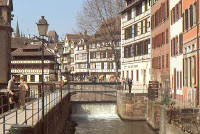
A lot of things in Alsace seem as much German as French even today.
The local dialect, still very common in many villages & especially amongst the older generation, sounds like 75% German & 25% French.
The traditional half-timbered houses, smartly maintained & brightly geraniumed, look more like Germany on the other side of the Rhine, than France on the other side of the Vosges.
Many of the official buildings & showpiece squares date from the German period in the late 1800s.
Notably "Place de la Republique", including the Prefecture, Strasbourg National Theater, the huge University Library & the ex-Emperor's Palace.
Or the impressive University Restaurant building, proudly labelled "Germania" then "Gallia" then "Germania" & now "Gallia" again.
 In Place de la Republique is Strasbourg's poignant war memorial dating from 1936 (French period) but dedicated simply to "our dead" without reference to either country.
It shows a mother (Strasbourg) with her 2 dying sons, one turned towards France & the other towards Germany.
Parting thot: "Forgiveness is the answer to the child's dream of a miracle by which what is broken is made whole again, what is soiled is again made clean." - Dag Hammarskjold
 About 10 years ago, when we still had kids all over the place, we installed an 8m x 4m swimming pool in the garden.
I'm not totally convinced it was a good idea, but we have it now so we keep using it & enjoying it, in spite of the ecological reservations.
We initially filled it with 48 cubic meters of tap water (what else?).
During the first year or so, we had to add tap water occasionally to keep the level up to the recommended mark.
Every spring, following instructions, we drained one third of the water out & refilled with 16 m3 of new tap water.
This was expensive & embarrassing.
For the last 3 years, we have not added any tap water at all, which pleases me economically & ecologically.
How?
A combination of several small ideas…
We keep the floating cover on the pool whenever it is not in use.
This reduces the evaporation of water & probably of active chemicals too.
When removing the floating cover, we roll it up slowly, so water on its dimpled underside has time to run back into the pool.
Then we stand one end of the rolled-up cover on a small block for a few minutes, so several more liters of water run back into the pool instead of getting lost elsewhere.
One of the skimmers has an overflow to prevent the pool over-filling in heavy rain, but whenever the pool does fill to that level, then as soon as it is used, the level falls several centimeters below the overflow lip.
This is because of surface waves – water keeps disappearing down the overflow so long as the tips of the waves are above the overflow.
So we have blocked the overflow with a removable rubber bung, knowing that we now have to keep an eye on the level after heavy rain.
The level does now get above the overflow, and can stay there for days or weeks, but so far has never got high enough to need any draining.
This means it takes a long time after heavy rain for the level to sink to the "add" mark – in fact it rarely does now.
When it does get that low, we have to keep an eye on it, to make sure the circulation stays OK until the next rain, but so far it always has.
But what about the 16 m3 refill every spring?
Well, we now do the draining in the autumn, then leave the concave winter cover on, which drains all rainfall through a central mesh into the pool.
By the time we want to use the pool in the spring, it is up to a useable level by rain & snow alone – at least it has been so far, though maybe not guaranteed every year.
But 16 m3?
No – now we only drain about half as much as was initially recommended & it seems OK so far.
Maybe because we found a more efficient treatment system.
After several years of juggling with fast & slow chlorine tablets, coagulants, anti-algae liquids etc etc, with frequent attacks of algae, cloudiness, green pool & so on, we tried Mareva Revaqua.
This is a pre-packaged 'sock' with doses of several elements (chlorine based) which you simply add to the skimmer once a week, with a measured dose of their anti-algae liquid.
In 4 or 5 years use, we have never had any off-colour water or other bother.
The snag is that it is more expensive than traditional chlorine tablets etc – if you renew it every week.
But after a long period of satisfactory use, we tried stretching it to every 10 days, which was OK, then every 2 weeks, then every 3 weeks and now even every 4 weeks except when the pool is around 30°C.
And it still works just fine, so it's not expensive at all.
And because we use so little chemicals, we think (hope) we can get away with changing less water every winter.
And that's how we get by with no added tap water.
Now we need to find a way to use less electricity for the circulation/filtration system…
Parting thot: "When you reach the top, keep climbing." – Zen proverb
 Here are a couple of quite common, but not obvious, expressions in French, using "wooden".
To have a "Gueule de bois", literally wooden face/mouth/gob actually means to have a hangover.
As far as I remember, it is quite a good description of the phenomenon.
To speak in "Langue de bois", literally wooden tongue/language is to use only standard pre-set expressions, preferably lofty-sounding but meaningless waffle & certainly unrelated to the subtleties of the context.
Typically used by politicians & officials & probably most typically by communist leaders & spokesmen.
Short training course, if your French is up to it, at:
http://ddata.over-blog.com/xxxyyy/0/00/38/87/animation-blog/langue-de-bois.pdf
Parting thot: "Education is what survives when what has been learnt has been forgotten." - B. F. Skinner
 Another area of regression in modern vehicles also concerns safety & vision, but is thankfully not general.
Vehicle lighting has been improving steadily for decades and European lighting in particular is excellent.
For instance, orange flashing turn-indicators are clearly better than the red & white indicators still found in USA.
But recently, some new models, particularly from VW group, for example Polo & Passat, have taken to diffusing the turn indicator lamps concentrically round the outside of the rear lamps & brake lamps.
Presumably this is a new possibility offered by LED lighting, which stylists have jumped at because it produces very pretty lamps.
The result is that when rear lamps & brake lamps are on (not an unusual situation) then the turn indicators get lost in the general glare & it is only too easy to fail to see them.
Similar effects are appearing at the front of some new vehicles, where the turn indicators are being integrated closely into a compound front lighting unit, so that they are much too close to the headlamps and therefore invisible when headlamps are on.
At the same time as drivers are being encouraged, or compelled, to drive with headlights on all the time.
In hindsight, it seems obvious that turn signal lamps should be physically separated from headlamps & brake lamps.
By some minimum distance which no doubt could be established scientifically.
The best-ever rear turn signal lamps were on the Citroen DS where they were put at the upper corners of the rear screen.
Immediately visible even in traffic & nowhere near other lights.
That should be compulsory.
Like the third brake lamp has become & for the same reasons.
Again, where is the pressure going to come from, to counteract economic & styling pressures which are leading us to pretty & economical but unsafe solutions?
Parting thot: "To me success can only be achieved through repeated failure and introspection." – Soichiro Honda

 Of course I like trees & appreciate their invaluable contribution to our well-being.


